Northeast India is rapidly transforming from a geographically isolated region into a strategic growth engine for the country. With increasing investments, infrastructure upgrades, and policy focus, the region is witnessing a new wave of development. At the same time, it faces persistent challenges such as connectivity gaps, environmental concerns, and socio-political complexities. This blog by Desh Headline explores the latest regional updates, opportunities, and challenges shaping Northeast India in 2026.
What Does Northeast India Include
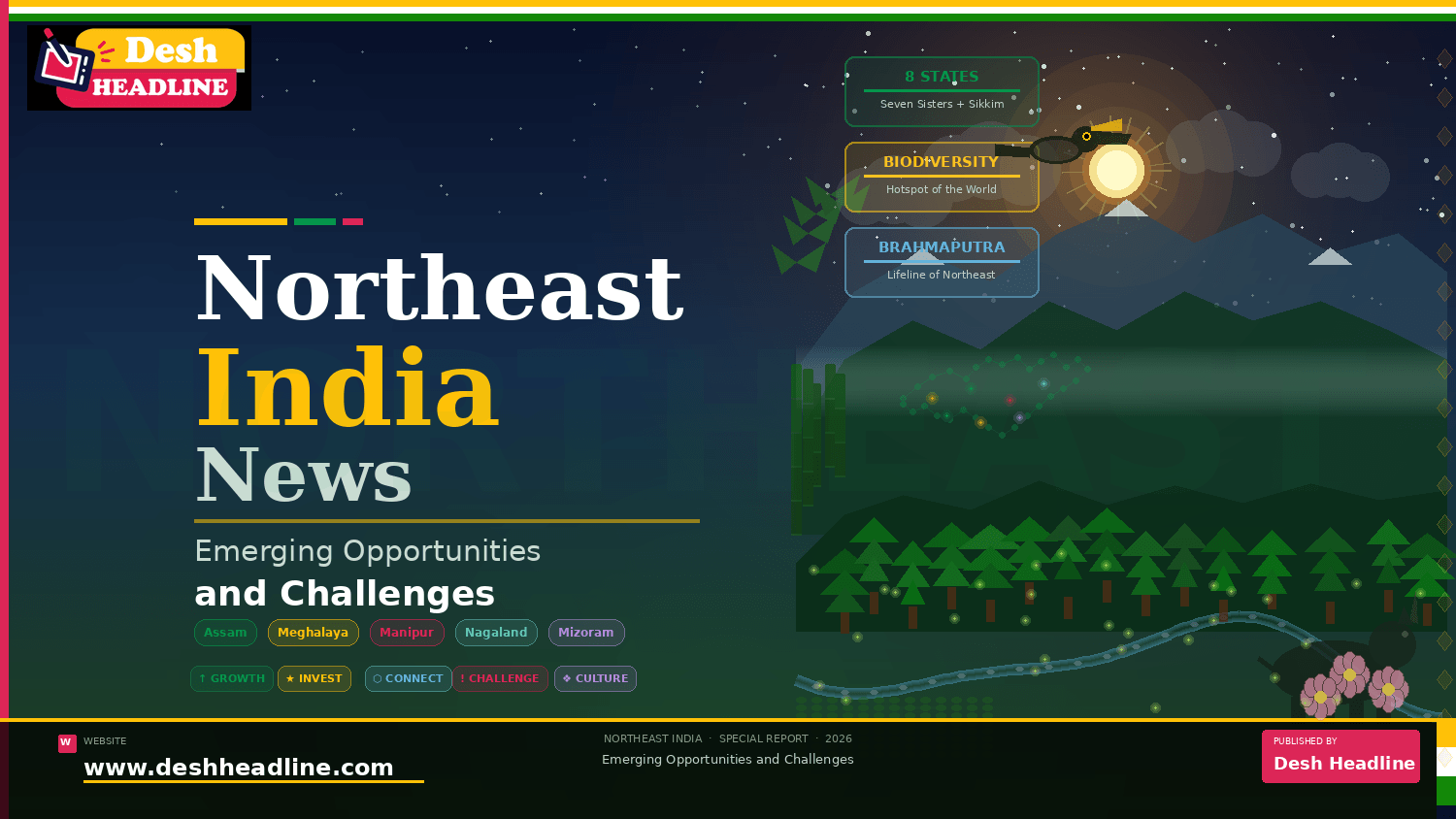
Northeast India comprises eight states-Assam, Arunachal Pradesh, Manipur, Meghalaya, Mizoram, Nagaland, Tripura, and Sikkim. Often referred to as the “gateway to Southeast Asia,” the region holds immense strategic and economic importance.
Recent statements by policymakers highlight that the Northeast is becoming a bridge between India and global markets, opening new avenues for trade, culture, and diplomacy.
Economic Growth and Investment Trends
The Northeast is emerging as a high-potential investment destination. Large-scale initiatives such as the Rising Northeast Investors Summit have attracted massive interest, with investment proposals crossing ₹4.3 lakh crore.
Key highlights:
- Assam is leading the region’s economic growth with strong industrial and agricultural contributions.
- MSMEs and startups are receiving financial support through credit schemes.
- Employment generation is a major focus, with promises of job creation and entrepreneurial support.
This economic push is transforming the region into a new growth frontier for India.
Infrastructure Development and Connectivity
Infrastructure remains the backbone of Northeast India’s transformation.
Recent Developments:
- The inauguration of major projects worth ₹5,450 crore in Assam is boosting connectivity and modernization.
- The Kumar Bhaskar Varma Setu bridge enhances transport across the Brahmaputra River, improving regional mobility.
- Railway expansion projects like the Murkongselek–Pasighat line are strengthening interstate connectivity.
- A ₹1,000+ crore water management project in Guwahati aims to ensure reliable urban infrastructure.
Despite progress, connectivity gaps still exist in remote hilly regions where road density and rail access remain limited.
Tourism and Cultural Expansion
Tourism is one of the fastest-growing sectors in Northeast India.
Key Highlights:
- Government initiatives are promoting eco-tourism and cultural tourism.
- Events like music conferences in Arunachal Pradesh are boosting the creative economy.
- Projects like the “Border Brew Cafe” aim to enhance tourism in remote areas.
The region’s natural beauty, tribal heritage, and festivals make it a unique destination for both domestic and international travelers.
Technology and Industrial Opportunities
The Northeast is entering a new era of industrialization and digital transformation.
Emerging Opportunities:
- Establishment of a semiconductor facility in Assam is seen as a turning point for technological growth.
- Development of science hubs like Science City in Guwahati promotes innovation and education.
- Increasing focus on startups, IT services, and digital infrastructure.
These initiatives are positioning the region as a future hub for tech-driven industries.
Government Policies and Budget Support
Government support has been a major driver of growth in Northeast India.
Budget 2026 Highlights:
- 47% increase in funding for the Development of North Eastern Region (DoNER).
- Focus on tourism, healthcare, education, and green infrastructure.
- Special programs for women entrepreneurs and rural livelihoods.
State-level initiatives are also contributing significantly:
- Development of border villages under strategic programs.
- Large-scale infrastructure and welfare commitments in Assam.
Key Challenges Facing Northeast India
Despite rapid progress, several challenges persist:
1. Connectivity Issues
Remote terrain and difficult geography hinder transport and logistics development.
2. Economic Disparities
While states like Assam are progressing, others still lag behind in industrial growth.
3. Limited Private Investment
Private sector participation is growing but still needs improvement.
4. Employment Gaps
Job creation remains uneven, particularly in rural areas.
Environmental and Climate Concerns
Northeast India is highly sensitive to environmental changes.
Major Issues:
- Frequent floods in Assam affecting livelihoods and infrastructure.
- Climate variability impacting agriculture and biodiversity.
- Deforestation and ecological imbalance due to development projects.
Balancing development with sustainability is a key challenge for policymakers.
Social and Political Dynamics
The region’s diversity is both a strength and a challenge.
Key Aspects:
- Ethnic diversity requires inclusive governance.
- Political competition is intensifying, especially in Assam elections.
- Welfare schemes targeting women, farmers, and tribal communities are gaining focus.
These dynamics play a crucial role in shaping the region’s future.
Future Outlook
Northeast India is on the path to becoming a major contributor to India’s growth story.
What Lies Ahead:
- Expansion of connectivity with Southeast Asia through trade corridors
- Growth in tourism and cultural industries
- Increased digital and industrial investments
- Stronger integration into national and global markets
As highlighted by policymakers, the region is no longer a frontier-it is a strategic growth engine for India.
Conclusion
Northeast India stands at a pivotal moment in its development journey. With strong government support, growing investments, and cultural richness, the region is unlocking new opportunities across sectors. However, addressing challenges such as infrastructure gaps, environmental sustainability, and socio-political complexities remains essential.
As covered by Desh Headline, staying updated with Northeast India news is crucial to understanding how this dynamic region is shaping India’s future.
FAQs
Why is Northeast India important for India’s economy?
Northeast India acts as a gateway to Southeast Asia and offers vast potential in tourism, trade, and natural resources.
What are the key industries growing in the Northeast?
Key industries include tourism, agriculture, handicrafts, IT, and emerging sectors like semiconductors.
What challenges does the region face?
Major challenges include connectivity issues, environmental risks, and economic disparities.
How is the government supporting the region?
Through increased budget allocation, infrastructure projects, and schemes for MSMEs, tourism, and rural development.
Is Northeast India becoming a tech hub?
Yes, with initiatives like semiconductor plants and science hubs, the region is moving toward technology-driven growth.