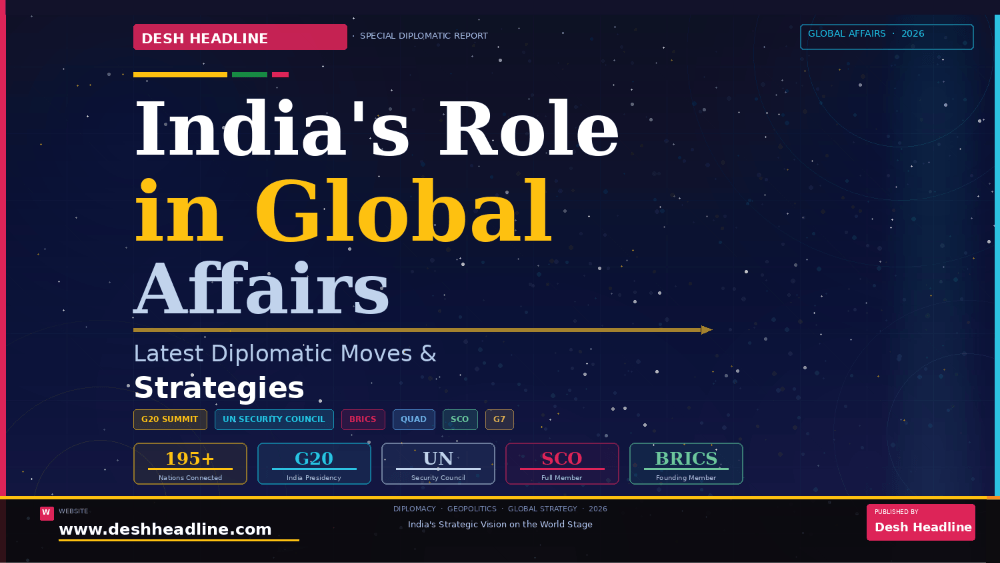
India is rapidly emerging as a key player in global geopolitics, balancing economic ambitions, security concerns, and diplomatic partnerships. In an increasingly multipolar world, the country’s foreign policy has shifted from traditional non-alignment to a more dynamic, interest-driven strategy. This transformation is shaping how India engages with global powers, regional neighbors, and developing nations. In this detailed blog by Desh Headline, we explore India’s latest diplomatic moves, evolving strategies, and its growing influence in global affairs.
India in a Changing World Order
The global order is undergoing significant changes due to geopolitical tensions, economic shifts, and technological advancements. India has positioned itself as a stabilizing force, navigating complex relationships with major powers like the United States, Russia, and China.
Unlike earlier decades, India is no longer a passive participant-it is actively shaping global policies, influencing trade negotiations, and contributing to international peace and security.
Evolution of India’s Foreign Policy
India’s foreign policy has evolved through multiple phases:
- Non-Alignment Era (Cold War): Maintaining neutrality between blocs
- Post-1991 Liberalization: Focus on economic diplomacy
- 21st Century Strategy: Multi-alignment and strategic autonomy
Today, India practices multi-alignment, engaging with multiple global players simultaneously without being tied to any single bloc.
This shift allows India to maximize its strategic and economic interests while maintaining independence in decision-making.
Key Diplomatic Moves in 2026
1. Balancing West Asia Relations
India has successfully maintained strong ties with countries like Iran, Israel, and Gulf nations simultaneously. Recent diplomatic efforts ensured safe trade routes through the Strait of Hormuz, highlighting India’s strategic agility.
Additionally, India has strengthened partnerships such as:
- Strategic ties with Israel
- Long-term development of Iran’s Chabahar Port
2. Energy Diplomacy with Russia
India continues to balance relations with Russia and Western nations. Amid global tensions, India has explored renewed energy partnerships with Russia to secure oil and gas supplies.
3. Trade Negotiations and WTO Stance
India has taken a firm stance in global trade discussions, particularly at WTO reform talks. It has emphasized:
- Protection of domestic industries
- Food security concerns
- Opposition to unfair trade rules
4. Critical Minerals Diplomacy in Africa
India is expanding its presence in Africa to secure critical minerals like lithium and cobalt-essential for clean energy and technology sectors.
India’s Role in Major Global Alliances
India is actively participating in both traditional and emerging global platforms:
QUAD (India, US, Japan, Australia)
- Focus on Indo-Pacific security
- Maritime cooperation and infrastructure
BRICS
- Promoting financial alternatives to Western systems
- Expanding global economic cooperation
India–EU Partnership
India recently signed a major Free Trade Agreement with the European Union, boosting trade and economic integration.
These alliances reflect India’s flexible approach-working with diverse partners for mutual benefit.
Strategic Autonomy and Multi-Alignment
India’s foreign policy is defined by strategic autonomy, allowing it to:
- Maintain relations with both the US and Russia
- Engage with China while addressing border issues
- Lead global discussions without external pressure
This approach ensures India remains independent while maximizing global influence.
India and the Global South Leadership
India has emerged as a strong voice for developing nations, often referred to as the Global South.
Key contributions include:
- Advocacy for fair global governance
- Capacity-building programs across 160+ countries
- Inclusion of the African Union in global platforms like G20
India’s philosophy of “Vasudhaiva Kutumbakam” (The world is one family) guides its global outreach.
Economic Diplomacy and Trade Agreements
Economic diplomacy is a cornerstone of India’s global strategy.
Key Highlights:
- Expanding trade partnerships across Europe, Africa, and Asia
- Strengthening supply chains
- Promoting manufacturing and exports
India’s pragmatic approach focuses on economic growth, energy security, and global competitiveness.
Defense, Security, and Technology Diplomacy
India is increasingly active in global security and defense discussions.
Key Developments:
- Commitment to nuclear stability and deterrence
- Focus on responsible use of military AI
- Strengthening maritime security
India is also integrating defense with economic and technological policies to enhance global influence.
Challenges in India’s Global Strategy
Despite its growing influence, India faces several challenges:
1. Geopolitical Tensions
- US-China rivalry
- Conflicts in West Asia
2. Trade Disputes
- WTO disagreements
- Tariff pressures
3. Regional Instability
- Neighboring countries’ political changes
- Security concerns in South Asia
4. Diplomatic Criticism
Domestic political debates continue to question foreign policy decisions, reflecting diverse viewpoints in Indian democracy.
Future Outlook: India as a Global Power
India’s future in global affairs looks promising due to:
- Strong economic growth
- Strategic geographic location
- Expanding diplomatic network
Experts believe India will play a key role in shaping the next global order, especially in areas like:
- Climate change
- Digital governance
- Global trade
Its ability to act as a bridge between developed and developing nations makes it uniquely positioned in international politics.
Conclusion
India’s role in global affairs is no longer limited-it is expanding rapidly across diplomacy, trade, and security. The country’s strategy of multi-alignment, strategic autonomy, and economic diplomacy has allowed it to navigate complex global challenges effectively.
As highlighted by Desh Headline, India’s diplomatic journey reflects a nation that is confident, adaptable, and increasingly influential on the world stage.
FAQs
What is India’s current foreign policy approach?
India follows a multi-alignment strategy, maintaining relations with multiple global powers while preserving strategic autonomy.
Why is India important in global geopolitics?
India’s economic growth, population size, and strategic location make it a key player in global trade, security, and diplomacy.
What is India’s role in the Global South?
India acts as a leader and advocate for developing nations, promoting equitable global governance and cooperation.
How does India balance relations with the US and Russia?
India maintains independent relations with both countries, focusing on national interests rather than alliances.
What are India’s major diplomatic challenges?
Key challenges include geopolitical tensions, trade disputes, and regional instability.
What is the future of India’s global role?
India is expected to become a leading global power, influencing economic, political, and technological developments worldwide.