
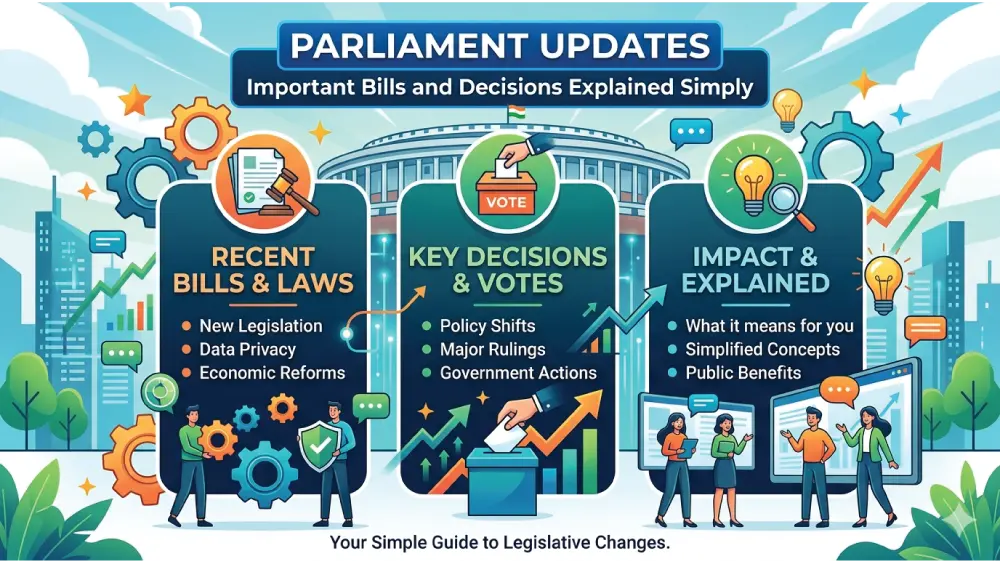
India’s parliamentary system plays a crucial role in shaping the nation’s future. Every session of the Parliament of India brings forward new bills, debates, and decisions that directly impact citizens, businesses, and governance. For many people, however, understanding parliamentary updates can feel overwhelming due to complex legal language and procedures. In this blog, we break down the latest parliament updates in simple terms, helping you stay informed about ever-evolving India News. Whether you’re a student, professional, or general reader, this guide will make parliamentary developments easy to understand.
Functioning of Parliamentary
The Indian Parliament consists of two houses: the Lok Sabha (House of the People) and the Rajya Sabha (Council of States). Together, they are responsible for:
- Making laws
- Discussing national issues
- Approving budgets
- Holding the government accountable
A bill must pass through both houses and receive approval from the President of India to become law.
Understanding these basics is essential before diving into the latest updates.
Key Bills Introduced Recently
Recent parliamentary sessions have seen several important bills introduced. Let’s simplify some of the most significant ones:
a) Digital Data Protection Bill
This bill focuses on protecting citizens’ personal data online. Key highlights include:
- Stricter rules for companies handling data
- User consent requirements
- Penalties for data breaches
This bill is crucial in today’s digital era where privacy concerns are rising.
b) Uniform Civil Code (Discussion Phase)
Although not yet fully implemented, discussions around a Uniform Civil Code (UCC) aim to:
- Create a common set of laws for all religions
- Promote equality and national integration
The topic has sparked nationwide debate due to its social and cultural implications.
c) Green Energy Transition Bill
To support India’s climate goals, this bill proposes:
- Increased investment in renewable energy
- Incentives for solar and wind power
- Reduction in carbon emissions
This aligns with India’s commitments under global climate agreements.
d) Education Reform Amendment
This bill aims to improve education standards by:
- Introducing skill-based learning
- Updating curriculum frameworks
- Enhancing teacher training programs
It complements policies like the National Education Policy 2020.
Important Decisions Taken in Parliament
Apart from bills, Parliament has made several impactful decisions:
Budget Allocations
The annual Union Budget determines how funds are distributed across sectors like:
- Healthcare
- Infrastructure
- Defense
- Education
These decisions influence economic growth and development priorities.
Policy Approvals
Key national policies are debated and approved, ensuring transparency and accountability in governance.
Amendments to Existing Laws
Parliament frequently updates older laws to match modern requirements. This ensures:
- Better governance
- Reduced legal loopholes
- Improved citizen protection
Economic and Social Impact of These Bills
Every bill passed in Parliament has real-world consequences.
Economic Impact
- Boost to industries through policy reforms
- Job creation via infrastructure and energy projects
- Improved investor confidence
Social Impact
- Enhanced data privacy rights
- Equal legal frameworks (if UCC is implemented)
- Better education opportunities
For example, digital protection laws directly affect how companies operate and how safe citizens feel online.
Opposition and Public Reactions
Parliamentary decisions often trigger debates between ruling and opposition parties. Leaders like Narendra Modi and Rahul Gandhi frequently present contrasting views on major bills.
Common Areas of Debate:
- Constitutional validity
- Impact on minority communities
- Economic feasibility
Public opinion also plays a major role, especially in the age of social media where citizens actively voice their perspectives.
Why These Updates Matter to You
You might wonder: Why should I care about Parliament updates?
Here’s why:
- Laws affect your daily life (taxes, education, privacy)
- Government policies shape job opportunities
- Economic decisions influence prices and income
Staying updated helps you make informed decisions as a citizen.
Role of Media in Simplifying Parliament News
Platforms like Desh Headline play a vital role in breaking down complex parliamentary discussions into easy-to-understand content.
In today’s fast-paced world, reliable sources of India News ensure that citizens remain aware of:
- Policy changes
- Government decisions
- National developments
Digital media has made it easier than ever to access real-time updates.
Conclusion
Parliamentary updates are more than just political news-they are the backbone of India’s progress. From digital privacy laws to education reforms and green energy initiatives, every decision shapes the nation’s future.
Understanding these developments doesn’t require a legal background. With simplified explanations, platforms like Desh Headline ensure that everyone can stay informed about ever-evolving India News.
As an aware citizen, keeping track of Parliament updates empowers you to participate actively in democracy and understand the direction in which the country is heading.
FAQs
What is a bill in the Indian Parliament?
A bill is a proposed law that must be approved by both houses of Parliament and the President before becoming an act.
How does a bill become a law in India?
A bill goes through multiple stages: introduction, debate, voting in both houses, and final approval by the President.
Why are parliamentary debates important?
Debates ensure transparency, allow different viewpoints, and improve the quality of laws.
What is the role of the opposition in Parliament?
The opposition questions government decisions, suggests improvements, and ensures accountability.
How can citizens stay updated with Parliament news?
Citizens can follow reliable news platforms, official government websites, and blogs like Desh Headline.
What impact do Parliament decisions have on daily life?
They influence taxes, education, employment, digital privacy, and overall economic conditions.